The short answer
We localized a 24-second English espresso demonstration into French, then found a caption that displayed only a period for 55 milliseconds. The corrected caption renderer keeps punctuation with the words and balances text across pages. This example shows the source, the revised output and the checks performed; it is a team test, not a customer success claim.
What the source contains
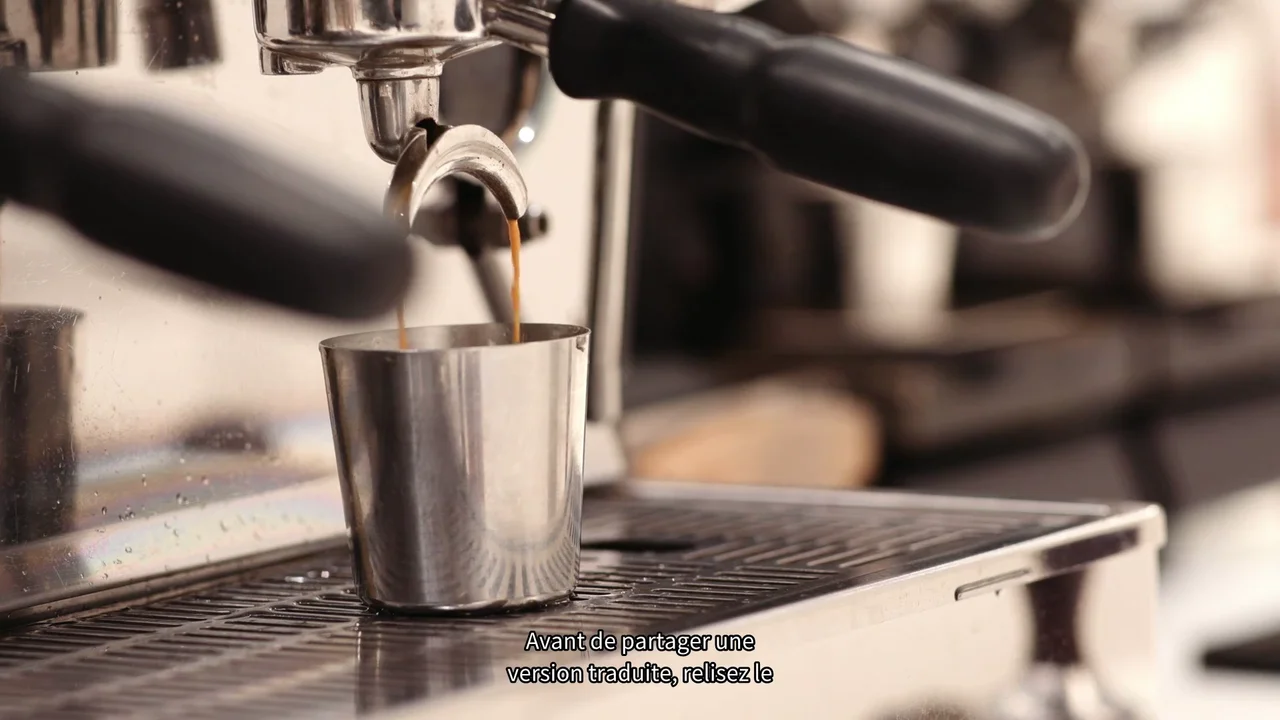
The source combines licensed Mixkit espresso footage, an original English script and synthetic narration. The underlying stock clip was silent; the English voice is not the recorded voice of a person in the café. We edited a 24-second version at 1920 × 1080 and 30 frames per second, leaving a short lead-in before the narration.
The script describes visible actions without inventing product specifications: coffee flows into a metal cup, the close-up shows the extraction, and captions help explain it with sound off. There is no customer name, sales result or claim that a particular machine performs better. This controlled example lets us compare the same content across languages.
Read the English transcript
This short demonstration shows an espresso machine in use. Coffee flows from the spout into a metal cup below. The close-up makes the brewing process easy to see. Clear captions can explain what is happening, even with the sound off. Before sharing a translated version, review the wording and check the subtitle timing.
What changed in the French version
We submitted the English source to Recast Studio with French as the target and permission to use the source narration. The generated voice describes the same sequence. The picture remains the original edited footage; this is dubbing and subtitling, not a replacement of the product or a lip-sync demonstration.
The player below uses that original generated French voice with captions re-rendered locally after a code correction. It was not downloaded from a second production job. Keeping the voice fixed let us isolate the subtitle issue and check the correction without introducing a different translation or new voice generation into the comparison.
Read the French transcript
Cette courte démonstration montre une machine à expresso en utilisation. Le café s'écoule du bec verseur dans une tasse métallique placée en dessous. Le gros plan permet de voir facilement le processus d'extraction. Des sous-titres clairs peuvent expliquer ce qui se passe, même sans le son. Avant de partager une version traduite, relisez le texte et vérifiez le synchronisme des sous-titres.
The problem: a period became its own caption
The first French export completed, but its subtitle file exposed a layout defect. At 12.505–12.560 seconds, one cue contained only a period. Other pages ended with very short fragments, including “dessous.” for 0.385 seconds. A completion status had not caught these presentation problems.
The renderer had wrapped text to a fixed width, grouped every two lines into a page, and divided the available time by text width. That combination could leave a small remainder on the final page. The exported SRT made the issue measurable; checking only the opening seconds of the video would have missed it.
6
00:00:12,505 --> 00:00:12,560
.
What we corrected and rechecked
The revised layout keeps punctuation attached to the text and balances content across the smallest number of two-line pages that fit. When the original sentence interval is long enough, each new page receives at least one second before the remaining time is distributed. Short source intervals are preserved rather than extended into the next sentence.
The corrected sample still has ten subtitle cues, but its shortest cue now lasts 1.694 seconds. All French text is retained, and the original sentence boundaries stay in place. We inspected the middle of every cue and the former period-only moment, and adjusted line wrapping so long pages did not leave a lone short word on the second line.
The result passed these caption and media checks. Timing within a sentence is still estimated from text layout, not measured word by word against the voice. A fluent reviewer should judge natural phrasing and synchronization before using a similar output in a customer-facing campaign.
| Check | First export | Corrected sample |
|---|---|---|
| Shortest cue | 0.055 seconds | 1.694 seconds |
| Period-only cue | One | None |
| French subtitle text | Original generated text | Same text, reflowed |
| Voice generation | One Recast cloud job | Reused original French voice |
| Review status | Caption defect found | Technical checks passed; no native-speaker sign-off |
Time and audio: what the measurements mean
The original cloud job took about 2 minutes 10 seconds from its recorded creation time to completion on November 2, 2026 (UTC). That excludes script preparation, upload preparation, downloading and review. It is one short clip in one language, so it cannot establish average turnaround time or savings against a human workflow.
The revised file has a 24-second picture. Its container reports 24.021 seconds because of AAC audio padding. Across the shared 24 seconds, the decoded audio correlation with the original French export was 0.99974 with no time-shift adjustment. Re-encoding means the files are not bit-identical; this comparison checks for an unexpected change in the reused track.
An independent automated audio review of the original source and French output found complete endings and no missing spoken content. That is supporting evidence, not a native French listening review. We have not measured audience comprehension, engagement, conversions or search visibility from this demonstration.
A review workflow you can repeat
Start with a short clip and a script whose facts you can verify. Save the clean source, the generated output and its subtitle file separately. Read the subtitle file as well as watching the video, paying attention to small trailing cues, punctuation and the final sentence. Record defects before replacing the evidence.
After correcting a problem, export a new version and check the same moments again. Compare the text, sentence boundaries, picture duration and audio. If you reuse a voice track, say so; if you run a fresh translation, treat it as a new result needing review. Finally, have an appropriate target-language reviewer assess meaning and delivery for your intended audience.
For your own product video, check names, numbers and visible labels that this simple clip does not exercise. The linked checklist covers that wider release review. If you already have approved captions and only need permanent text in the picture, use the separate browser burner instead of starting another translation job.